

Vienna, the charge of the winged hussars
On 12 September 1683, a Polish king launches his horsemen from the top of a hill. By evening, the siege of Vienna is lifted, and the Ottoman advance in Europe is broken.
A Thousand Years of Europe
Episode 04 · Defence
Date
12 September 1683
Under siege since 14 July
Place
Vienna, Kahlenberg hill
Where it is kept
musées du Vatican
Work
Jan Matejko, 1883
The story behind the painting
In July 1683, the Ottoman army besieges Vienna, capital of the Habsburgs.
On 12 September, a relief army led by the King of Poland John III Sobieski attacks from the hills. His cavalry brings down the Ottoman camp.
Vienna is saved. The Ottomans will never again come so far into Europe.
The grand vizier before Vienna
In the spring of 1683, the Ottoman army leaves Adrianople. The grand vizier Kara Mustafa leads it westward: it is one of the largest of its time. Part of Hungary is already Ottoman. Its objective: Vienna, the emperor's city.
On 14 July, the siege begins. Emperor Leopold I has left the city with his court. Count of Starhemberg defends it with his soldiers and the inhabitants. Ottoman sappers dig galleries under the ramparts and blow them up one after another. By early September, the city is at the end of its strength.
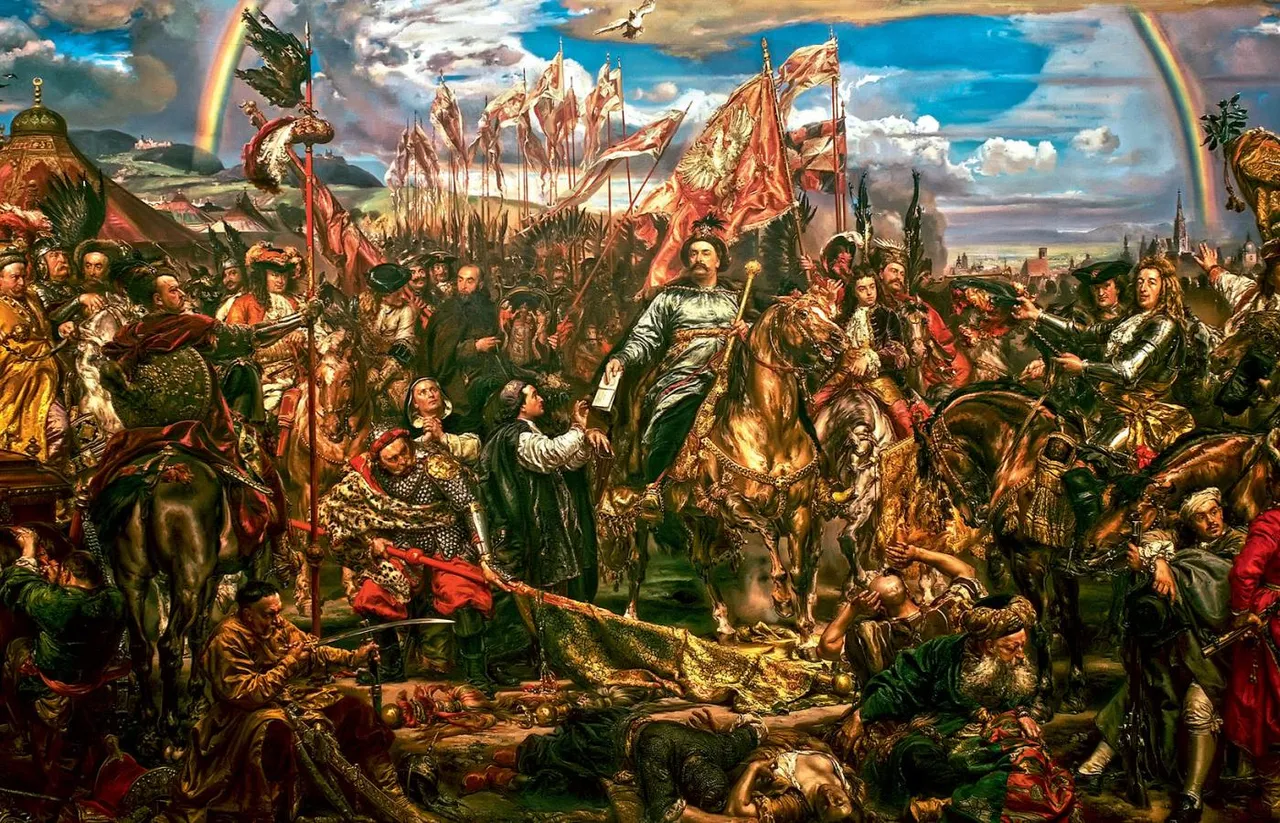
Behind the king, a forest of lances and standards. These are those of his horsemen, including the hussars, the Polish heavy cavalry, famous for the feather wings fixed to their backs.
A coalition of Europeans
In Rome, Pope Innocent XI urges the Christian princes to unite. The King of Poland, John III Sobieski, has signed an alliance with the emperor. He crosses Silesia and Moravia with his army.
On the way, he joins forces with the imperial troops of Charles of Lorraine, with the Bavarians, the Saxons, the Swabians and the Franconians. Sobieski, the only king present, takes command. One great absentee: Louis XIV, rival of the Habsburgs, who stays apart.
On 11 September, the relief army reaches the heights of the Kahlenberg. At its feet, Vienna still smokes under the fire, surrounded by the tents of the Ottoman army.
The charge of the Kahlenberg
On 12 September at dawn, the relief army descends from the hills, northwest of the city. The fighting lasts all day, from vineyard to vineyard.
Around 6 p.m., Sobieski launches his cavalry. About 18,000 horsemen pour down the slopes, the Polish hussars in the lead, the king with them. It is often described as the largest cavalry charge in history. The Ottoman lines give way. Kara Mustafa flees, abandoning his camp, his tents and his treasure.
We came, we saw, God conquered.
Sobieski hands his letter to a messenger, who must carry it to Rome. Matejko paints the moment when the victory becomes news for all Christendom.
The great ebb
In the evening, Sobieski writes to his wife. The booty, he says, is unheard of: tents, herds, and even camels.
Kara Mustafa does not survive his defeat. On 25 December 1683, he is strangled in Belgrade, on the sultan's orders.
The following year, the emperor, Poland, Venice and the pope form a Holy League. For sixteen years, they push the Ottomans back. In 1699, by the Treaty of Karlowitz, most of Hungary is liberated. Central Europe will never again be threatened in this way.
On the ground, abandoned Ottoman standards and an old man in a turban, fallen. Matejko places victory above and defeat at our feet.
A feast, every 12 September
A feast. In 1684, to give thanks for the victory, Innocent XI enters the feast of the Holy Name of Mary in the calendar of the whole Church. Since 1911, it falls on 12 September, the day of the battle. It recalls that at Vienna, Poles, Austrians and Germans fought side by side for one and the same city.