

Vienna, the charge of the winged hussars
On 12 September 1683, a Polish king launches his horsemen from the top of a hill. By evening, the siege of Vienna is lifted, and the Ottoman advance in Europe is broken.
A Thousand Years of Europe
Episode 04 · Defence
Date
12 September 1683
Under siege since 14 July
Place
Vienna, Kahlenberg hill
Where it is kept
musées du Vatican
Work
Jan Matejko, 1883
The story behind the painting
In July 1683, the Ottoman army besieges Vienna, capital of the Habsburgs.
On 12 September, a relief army led by the King of Poland John III Sobieski attacks from the hills. His cavalry brings down the Ottoman camp.
Vienna is saved. The Ottomans will never again come this far into Europe.
The grand vizier before Vienna
In the spring of 1683, the grand vizier Kara Mustafa leaves Adrianople at the head of one of the largest armies of his time. Part of Hungary is already Ottoman. His objective: Vienna, the emperor's city.
On 14 July, the siege begins. The emperor Leopold I has left the city. Count of Starhemberg defends it with his soldiers and the inhabitants. The Ottoman sappers dig galleries under the ramparts and blow them up one after another. At the beginning of September, the city is at the end of its strength.
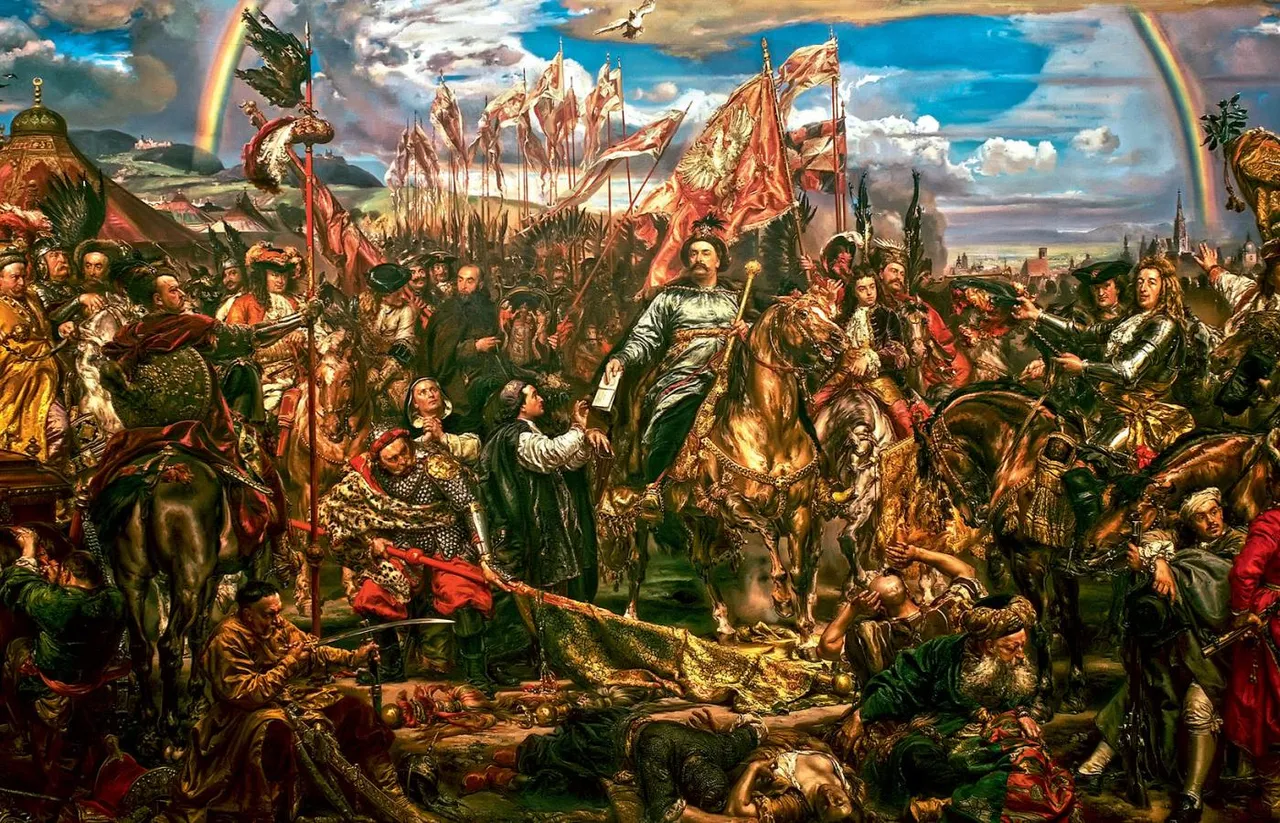
Behind the king, a forest of lances and standards. These are those of his horsemen, among them the hussars, the Polish heavy cavalry, famous for the wings of feathers fixed to their backs.
A coalition of Europeans
Pope Innocent XI urges the Christian princes to unite. The King of Poland, John III Sobieski, has signed an alliance with the emperor. He crosses Silesia and Moravia with his army.
He joins forces with the imperial troops of Charles of Lorraine, with the Bavarians, the Saxons, the Swabians and the Franconians. Sobieski takes command. One great absentee: Louis XIV, rival of the Habsburgs, who stays apart.
The charge from the Kahlenberg
On 12 September at dawn, the relief army comes down from the hills of the Kahlenberg, north-west of the city. The fighting lasts all day.
In the late afternoon, Sobieski launches his cavalry, the hussars at their head. It has often been described as the greatest cavalry charge in history. The Ottoman lines give way. Kara Mustafa flees, abandoning his camp, his tents and his treasure.
We came, we saw, God conquered.
Sobieski hands his letter to a messenger, who must carry it to Rome. Matejko paints the moment when the victory becomes news for all Christendom.
The great ebb
Kara Mustafa does not survive his defeat: he is executed at Belgrade on Christmas Day 1683, on the sultan's orders.
The following year, the emperor, Poland, Venice and the pope form a Holy League. For sixteen years, they push back the Ottomans. In 1699, by the Treaty of Karlowitz, Hungary is liberated. Central Europe will never again be threatened in this way.
On the ground, abandoned Ottoman standards and an old man in a turban, fallen. Matejko places the victory above and the defeat at our feet.
A word, before the treaties
A feast. To give thanks for the victory, Innocent XI extends to the whole Church the feast of the Holy Name of Mary, celebrated every 12 September, the day of the battle. And a lesson: on that day, Poles, Austrians and Germans fought side by side for one and the same city.