
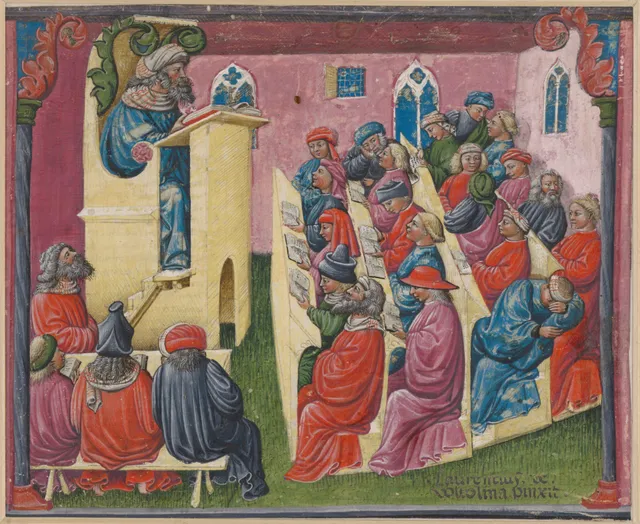
Bologna, when students paid their professors
The oldest university in the West was not founded by a king or a pope. The students invented it, and they fined their professors.
A Thousand Years of Europe
Episode 03 · Knowledge
Date
1088
Traditional date, fixed in 1888
Place
Bologna
Where it is kept
Kupferstichkabinett, Berlin
Work
Laurentius de Voltolina, seconde moitié du XIVe siècle
The story behind the painting
In Bologna, at the end of the 11th century, masters began teaching Roman law, rediscovered in the compilations of Justinian.
Students came from all over Europe and organised themselves into a corporation, the universitas. It was they who hired and paid the professors.
The model spread everywhere. Rector, faculty, doctorate: our words come from there.
A law book brought back from oblivion
At the end of the 11th century, an almost forgotten text resurfaced in Italy: the Digest, the great compilation of Roman law made under the emperor Justinian in the 6th century.
In Bologna, a master named Irnerius began to explain it, line by line, writing his commentaries in the margins. He would be nicknamed "the lamp of the law". His reputation attracted students from all over Europe.
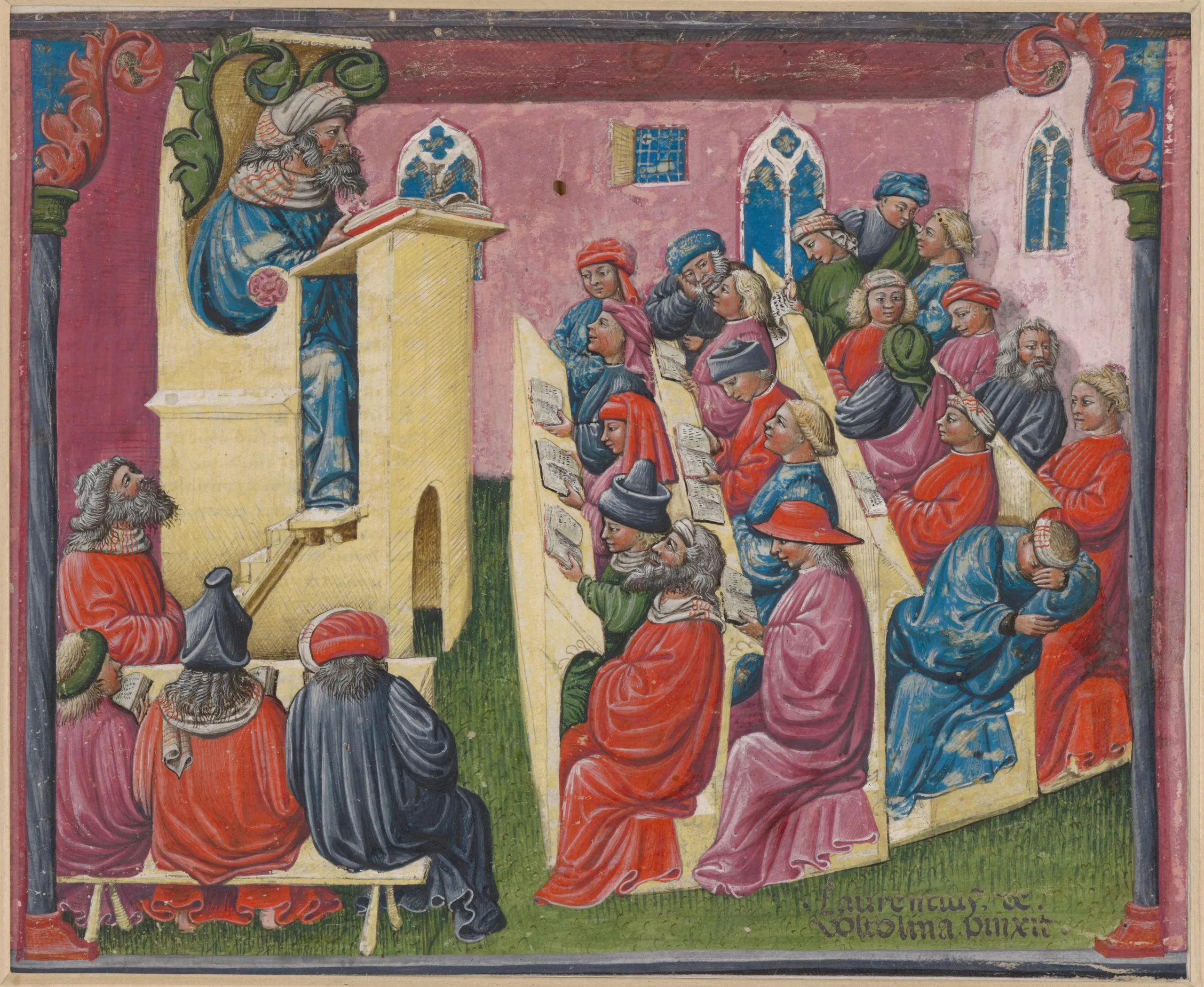
The master dominates the room from his chair and reads from a large book. To teach, in the Middle Ages, was first of all to read a text aloud, then to comment on it: hence the English word lecture.
Foreigners who organise
A German or English student in Bologna had no rights in the city. He could be arrested for the debts of a fellow countryman and pay a high price for his lodging.
So the students did what craftsmen did: they grouped together in a corporation, a universitas. They divided themselves into "nations" according to their origin, then into two large groups, those from this side of the Alps and those from beyond. Each elected its rector.
In 1155, the emperor Frederick Barbarossa took them under his protection: those who travelled to study could no longer be arrested for another's debts.
In front of each student, an open book. Manuscripts cost a fortune: in Bologna, booksellers rented them out quire by quire so that students could copy them.
The professor fined
It is the world turned upside down. The students recruited the professors and paid for their lessons. Their statutes set the rules, and the fines.
A master who started late, who skipped a difficult passage or who did not finish the programme at the end of the year had to pay. He could not leave the city without the permission of his students. The professors would eventually obtain salaries paid by the commune, and regain control.
The students are willing to learn, but not to pay.
In the front row, they follow the text. At the back, they chat, and one of the students seems to have fallen asleep. Six and a half centuries later, the scene has not aged a bit.
A model for all of Europe
From Bologna, the model went in every direction. Dissatisfied students founded Padua in 1222. Paris, Oxford, Salamanca, Prague and Kraków followed, each in its own way.
The university became one of the inventions that made Europe: a place where people came from every country, where the same language was spoken, Latin, and where one obtained a degree recognised everywhere, the licentia ubique docendi, the right to teach anywhere.
A word, before the treaties
Words and a date. Rector, faculty, doctorate, licence: our vocabulary comes from these students. As for the year 1088, it was fixed in 1888 by a commission chaired by the poet Giosuè Carducci, to celebrate the eight hundredth anniversary of the university. Lacking a founding act, Europe chose itself an anniversary.