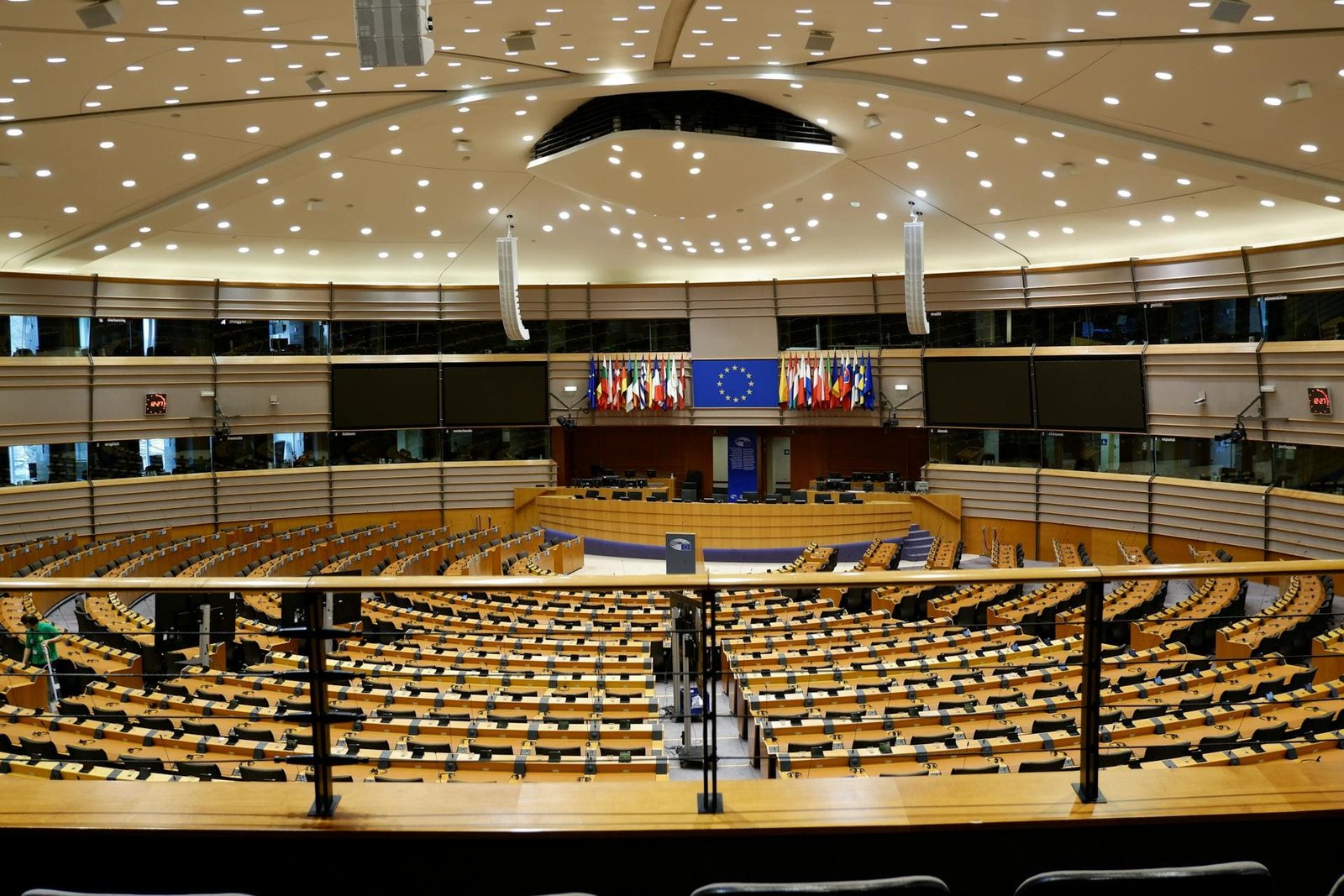
The European Parliament adopted amendments that extend the Temporary Decarbonisation Fund to downstream operators and to new sectors (cereals and cement), while setting precise calculation methods and deadlines for payments. The text amends the Commission's initial proposal, which covered only operators in carbon-intensive sectors. This is Parliament's first-reading position; the final text still has to be negotiated with the member states.
The Temporary Decarbonisation Fund is a new EU financial instrument intended to support companies exposed to a residual risk of carbon leakage for their exports to third countries. It is financed by the remaining 25% of revenue generated by the sale of Carbon Border Adjustment Mechanism (CBAM) certificates, with 75% to go to the EU budget. The Commission had proposed limiting this support to operators in carbon-intensive sectors. Parliament adopted amendments that considerably widen the scope of beneficiaries and specify the rules for calculation and payment.
Widening of beneficiariesSupport is no longer aimed only at operators in carbon-intensive sectors, but also at downstream operators, including in the cereals and cement sectors, which are added to aluminium, fertilisers, iron and steel.
Calculation method specifiedThe amount of aid is calculated on the basis of the volume of goods exported, the CO2 content of CBAM inputs or precursors used to produce them, and the average annual price of CBAM certificates over the reference period, with an adjustment for free allowances.
Retroactive eligibility from 1 January 2026Measures adopted before the entry into force of the regulation may receive support if they contribute to environmental objectives and were carried out from 1 January 2026.
Commission decisions by the end of 2027 and the end of 2028The Commission adopts decisions granting support by 31 December 2027 at the latest for lists received before 30 June 2027, and by 31 December 2028 at the latest for lists received before 30 June 2028.
Payments to final beneficiariesThe Commission transfers the full amount to the member states within one month of the decision, and national authorities pay the aid to final beneficiaries by 31 March 2028 or 31 March 2029 at the latest, depending on the decision concerned.
Parliament adopted the text by 433 votes in favour, 97 against and 146 abstentions in an electronic roll-call vote.
Exporting companies in sectors such as aluminium, fertilisers, iron and steel, but now also cereals and cement, will be able to apply for temporary financial aid to offset the risk of carbon leakage linked to their exports. Downstream operators, which process these materials, are also eligible, which widens the number of companies that can benefit. Payments are governed by precise dates: the first decisions are expected before the end of 2027 and payments to companies before the end of March 2028. The Fund is temporary and does not call into question the revision of the emissions trading system.
Parliament adopted its first-reading position on the Temporary Decarbonisation Fund: downstream operators, cereals and cement enter the scope, calculation methods and payment deadlines are set. This is an extension of scope, not a change of logic: public money still compensates for a risk that the Union's own trade policy created.
The mechanism is simple to describe: CBAM, the carbon border adjustment mechanism, taxes the carbon contained in imports. It does not tax exports. A European steel plant selling outside the Union therefore pays the carbon price at home and faces competitors who do not pay it. The Fund bridges this gap with 25% of CBAM revenues, with the remaining 75% proposed as an own resource in the future 2028-2034 budget.
Parliament widens this net: downstream operators, which process these materials, and two new sectors, cereals and cement, join the list. Each addition can be defended on its own. Added together, they turn a scheme targeted at residual export risk into a broad counter, fed by a revenue whose amount depends on imports, and therefore on factors no one controls.
The calculation is based on exported volumes, the CO2 content of inputs and the average annual price of certificates, adjusted for free allowances. The Commission must still specify these parameters through implementing acts. A company that wants to invest therefore knows neither the exact amount it will receive nor the final method. It does know the deadline, however: 31 March 2028 for the first decisions.
The Fund is temporary by construction: 2027, 2028, 2029, with an explicit clause in the text so that it does not serve as a precedent during the revision of the ETS. This caution is sound. But it reveals the problem: industrialists are being asked to launch heavy investments, over several decades, on the basis of three years of support whose renewal is explicitly ruled out. The entrepreneur who has to sign a ten-year order book does not need a temporary subsidy, he needs to know whether the carbon cost will apply to his foreign competitors.
Parliament adds conditions: climate neutrality plans, social criteria, demonstrable emission reductions. On paper, this directs money towards genuine transformation. In practice, each condition is an extra file, an extra check, an extra delay. For an SME, the compliance cost can exceed the amount of the aid. The text also provides that the Commission assess the structural obstacles faced by SMEs in exporting, which amounts to acknowledging that the scheme does not reach them.
An approach based on subsidiarity and the market would have done the opposite: instead of redistributing a tax revenue among sectors chosen in Brussels, it would have removed the distortion at its source. Either by exempting exports from the carbon cost, or by speeding up the conclusion of sectoral agreements with trading partners, or by letting Member States, which know their industrial fabric, decide on support.
The adopted text is a first-reading position, not a final agreement: the Council has yet to rule. The 433 votes in favour, 97 against and 146 abstentions express a broad but not unanimous majority, and the forthcoming compromise will tell whether the widening survives. What is certain is that the list of beneficiaries is growing faster than the substantive solution.
You do not relocate a factory because of a missing subsidy, but because of a competitor who does not pay the same carbon price.