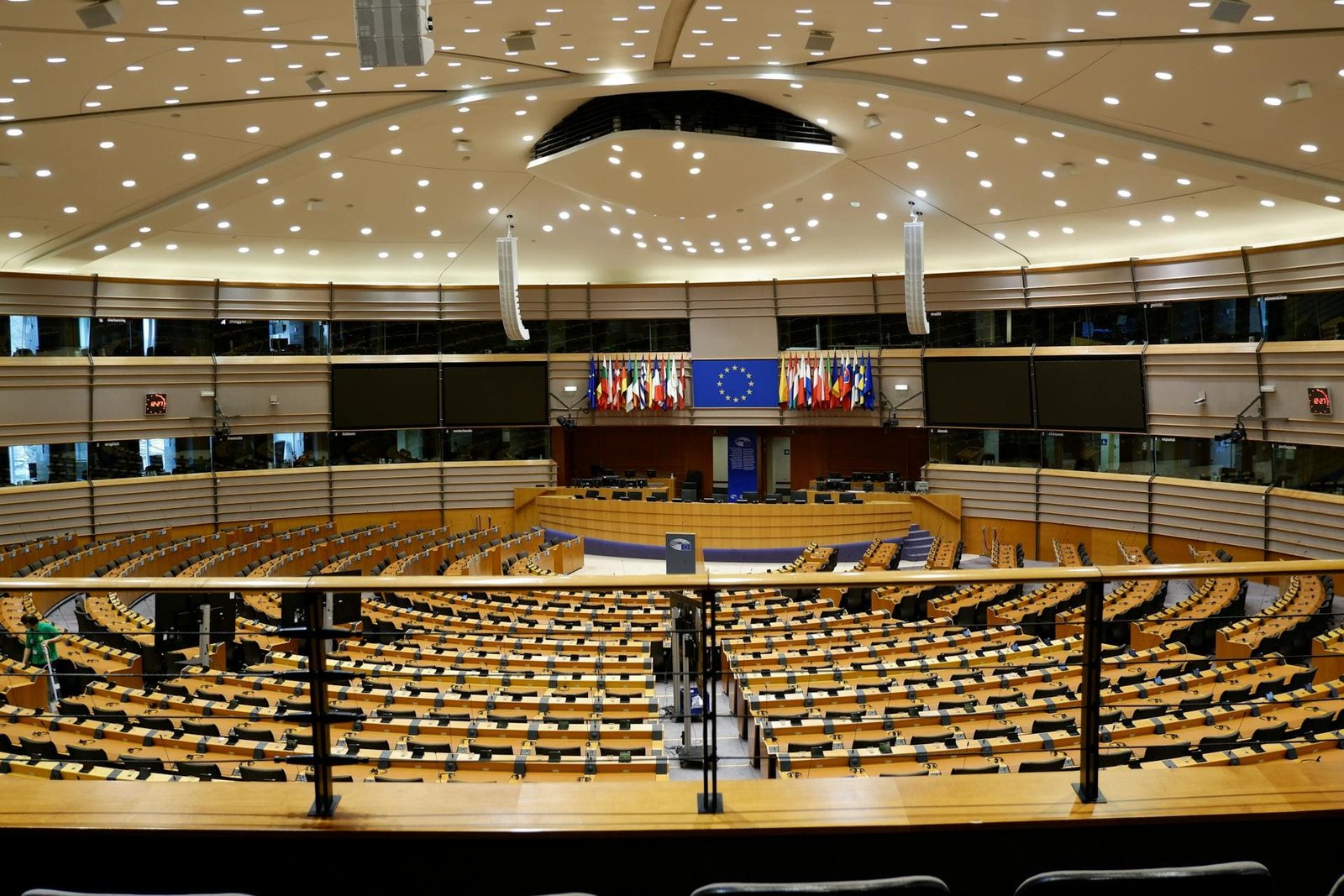
The European Parliament adopted a resolution condemning Russia's war against Ukraine and calling on the Union and its member states to increase their military aid to Kyiv, including air defence systems and long-range missiles. The text also calls for strong and legally binding security guarantees for Ukraine, as well as the immediate and unconditional withdrawal of all Russian forces from Ukrainian territory. Parliament is asking the Commission to act; this is not a law.
Each year, the Commission publishes a report on Ukraine that serves as the basis for a debate in Parliament. This report is a monitoring document: it does not propose any binding legislative measures. Parliament therefore adopted its own political position on the situation in Ukraine and on the response the European Union should provide.
Russian withdrawal demandedParliament demands that Russia immediately and unconditionally cease all its military activities in Ukraine and withdraw all its forces and all its military equipment from the entire Ukrainian territory, including its territorial waters.
More weapons for KyivIt calls on the Union and the member states to increase their military assistance to Ukraine, including air defence systems (Patriot, SAMP/T, NASAMS, IRIS-T, HAWK) and deep-strike capabilities. It urges Germany in particular to provide long-range Taurus missiles.
Binding security guaranteesParliament calls for strong and legally binding security guarantees for Ukraine, equivalent to those of Article 5 of the Washington Treaty and Article 42(7) of the Treaty on European Union, as soon as the state of war has officially ended.
Air protection zoneIt asks a coalition of willing member states to study the creation of an integrated air protection zone with a defensive purpose, led by Europe, which could deploy combat air patrols over uncontested areas of Ukraine.
Pressure on RussiaParliament condemns the partial easing of US sanctions against Russia and denounces the United States' position of making its security guarantees conditional on Ukraine's withdrawal from the Donbas. It calls for a just and lasting peace, with Russian reparations and accountability for war crimes.
The resolution was adopted by 460 votes in favour, 136 against and 59 abstentions in an electronic roll-call vote.
This vote does not impose any legal obligation on the member states or the European institutions. It expresses the European Parliament's political position on the war in Ukraine and on what the Union's response should be. In practice, it calls for sending more weapons to Ukraine, including air defence systems and long-range missiles, and for preparing security guarantees for the post-war period. It also demands that Ukraine be involved in any decision concerning it and that Europe take part in peace negotiations. Parliament is asking the Commission and the member states to act; this is not a law.
On 8 July 2026, the European Parliament adopted by 460 votes to 136 with 59 abstentions a resolution demanding the immediate and unconditional withdrawal of Russian forces from Ukraine and calling on the Union and its Member States to massively increase their military aid to Kyiv, including air defence systems and long-range missiles. This is not a law: it is a political position. But it says one simple thing: Europe must stop treating Ukrainian courage as a given and start funding it as an investment in its own security.
Parliament notes a 99% reduction in US military aid in 2025. This is not an abstraction: it is the signal sent to Moscow that time is on its side. In response, the resolution calls for accelerating and increasing the supply of weapons and ammunition, and stresses that the Union and its Member States are already the main provider of financial and military support to Ukraine. The mechanism is simple: if aid decreases, Ukraine's capacity to defend itself decreases, and Russia has no reason to negotiate. If aid increases predictably, the balance of power shifts and diplomacy becomes possible.
The text urges Germany in particular to supply long-range Taurus missiles, and the other Member States to provide Ukraine with additional air defence systems. For a European citizen, this means that the protection of their own airspace begins in Ukraine. Every missile intercepted over Kyiv is a missile that does not threaten Warsaw or Berlin. The cost of waiting, meanwhile, is measured in Ukrainian lives and in increased risks for Europe.
The resolution calls for strong and legally binding security guarantees for Ukraine, equivalent to those of Article 5 of the Washington Treaty and Article 42(7) of the Treaty on European Union, as soon as the state of war has officially ended. It also calls on a coalition of willing Member States to study a Europe-led integrated air protection zone with a defensive purpose, with combat air patrols over uncontested areas of Ukraine. These are not binding commitments, but political orientations. Their implementation will depend on the will of the Member States, and that is the crux of the problem: security guarantees are only worth something if they are credible, and they are only credible if European military capabilities follow.
Parliament invites the Commission and the Member States to consider appointing a high-level European negotiator with a clear mandate. It recalls that nothing about Ukraine without Ukraine, and nothing about Europe without Europe. This formula is right, but it requires Europe to speak with one voice. Yet national divisions over sending weapons or over security guarantees weaken the European position. An approach based on subsidiarity and the market would be more effective here: let willing Member States move forward together, without waiting for unanimity, and let the European defence industry produce faster by reducing regulatory obstacles. The EDIP, mentioned in the text, is a step in this direction, but it remains too slow and too bureaucratic to meet the urgency.
Parliament condemns the partial easing of US sanctions against Russia and the position of the United States of subordinating its security guarantees to Ukraine's withdrawal from the Donbas. It calls for expanding individual sanctions lists and for holding social media platforms responsible for the spread of harmful content, through strict enforcement of the Digital Services Act. This last point deserves attention: entrusting private platforms with filtering Russian state propaganda can backfire against freedom of expression. The fight against disinformation must remain within the framework of the law, not that of private censorship. The real lever is transparency of funding and criminal prosecution of propaganda networks, not delegating censorship to companies.
Europe cannot ask Ukraine to fight for it and deny it the means to do so.